What Can We Learn About Charleston’s Dolphins Through Local Fossils?
By Capt. Olivia
I’m obsessed with evolution. The ways in which every living thing is linked, the similarities we share, and the fascinating differences that can make some of our distant relatives seem downright alien. One of the evolutionary stories that I find the most interesting is the one that leads to our local superstar – the bottlenose dolphin. The lowcountry of South Carolina is a treasure trove of fossils, and those fossils show the incredible history of how our dolphins came to be.
Dolphins belong to the infraorder Cetaceans, a taxonomic classification that includes all whales, dolphins, and porpoises, both extant and extinct. All 90 species of modern day cetaceans fall into one of two subgroups: the toothed whales (orcas, dolphins, porpoises, etc), and the baleen whales (blue whales, humpbacks, etc).
Cetaceans are descended from terrestrial hoofed mammals, with the full transition from land to sea believed to have occurred around 45-50 million years ago. The oldest fossil evidence we have of a cetacean is Pakicetus (from Pakistan), an animal whose closest living relative outside of cetaceans is the hippopotamus. They looked a bit like a wolf with a nose at the end of an elongated snout, and hunted fish in shallow water.
During the Eocene epoch (56–34 million years ago), much of what is now coastal South Carolina was submerged beneath a warm, shallow sea. Sedimentary formations like the Tupelo Bay Formation and Santee Limestone captured the remains of early whales living along this ancient coastline.
One of the clearest pieces of evidence for whale evolution in South Carolina comes from protocetids—semi-aquatic whales that could still move on land. These animals likely lived much like modern seals: hunting in the water but still capable of hauling out onto land. A species called Carolinacetus gingerichi was discovered in Berkeley County. Its fossil remains include parts of the skull, vertebrae, and ribs, showing a mix of terrestrial and aquatic adaptations. We also find basilosaurid fossils from this time period – large, fully aquatic cetaceans with small hind limbs still present.
Fast forward to the Oligocene (34–23 million years ago), and the Charleston area becomes one of the richest whale fossil sites in the world. Formations like the Ashley and Chandler Bridge formations have produced dozens of early modern whales, including early toothed whales like Xenorophus, early baleen whales like Eomysticetus, and transitional forms like Coronodon, which had both teeth and early baleen structures. This period represents rapid evolutionary radiation, where whales diversified into the major groups we recognize today.
As you dig through South Carolina’s fossil record you see the development of modern cetacean characteristics: the hind limbs get smaller over time, the nostrils migrate gradually up from the tip of the snout to the top of the head, and tools for echolocation progress. A transition like this can be difficult to wrap your head around even with the fossil evidence; without the crucial pieces of the story that are preserved along our coast, it might be totally unfathomable.
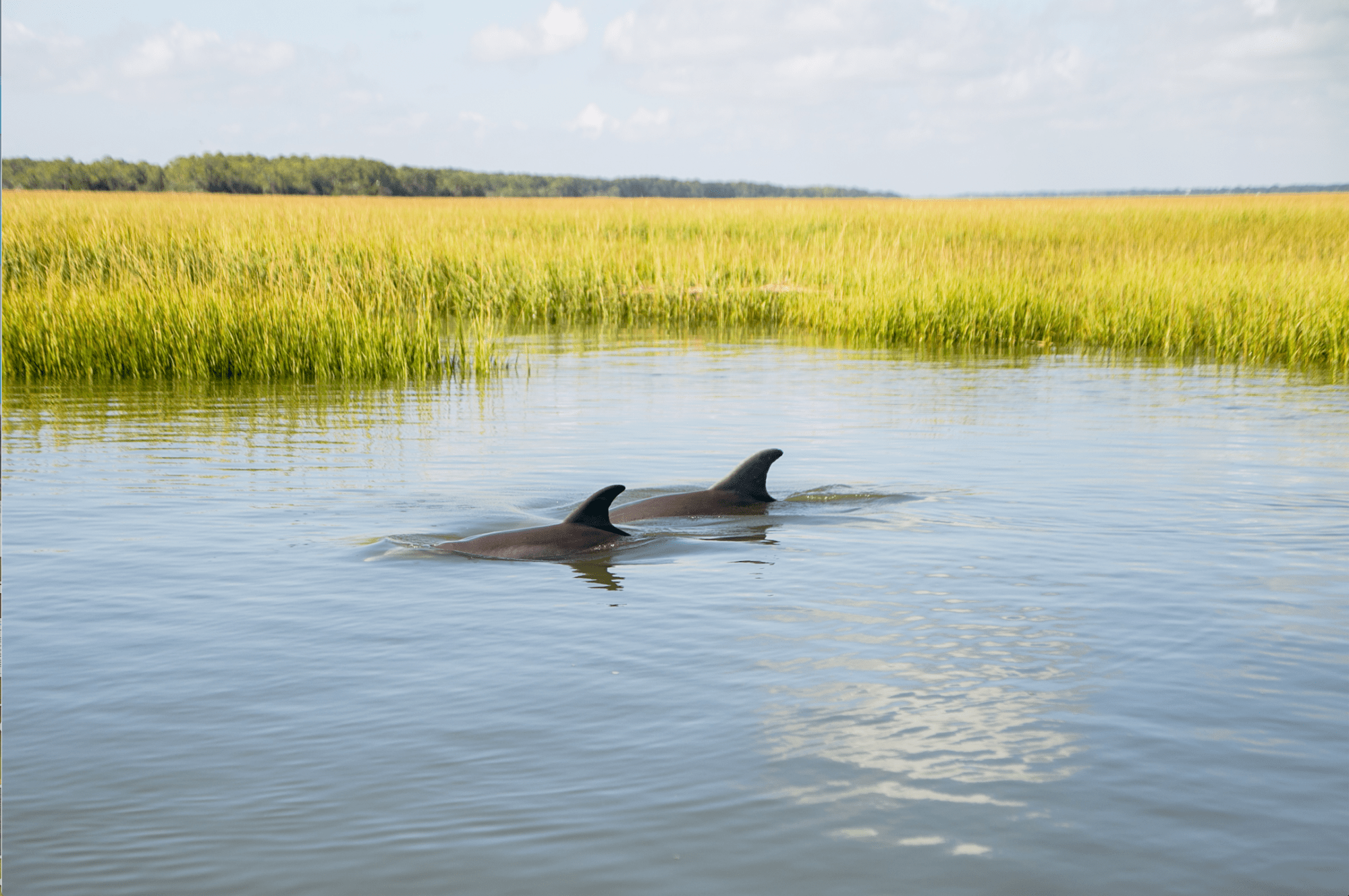
This makes the Lowcountry not only one of the best places in the world to see the Tamanend’s bottlenose dolphin, but it is also one of the best places to explore the long lineage of cetaceans that came prior.